
Stage & IP
Prototype
Patent pending
Certifications (UL, CE, RoHS) and first pilots on the roadmap.
Prototype stage · Patent pending
HeatSinc detects dangerous heat dissipation at the outlet and acts before it’s too late.
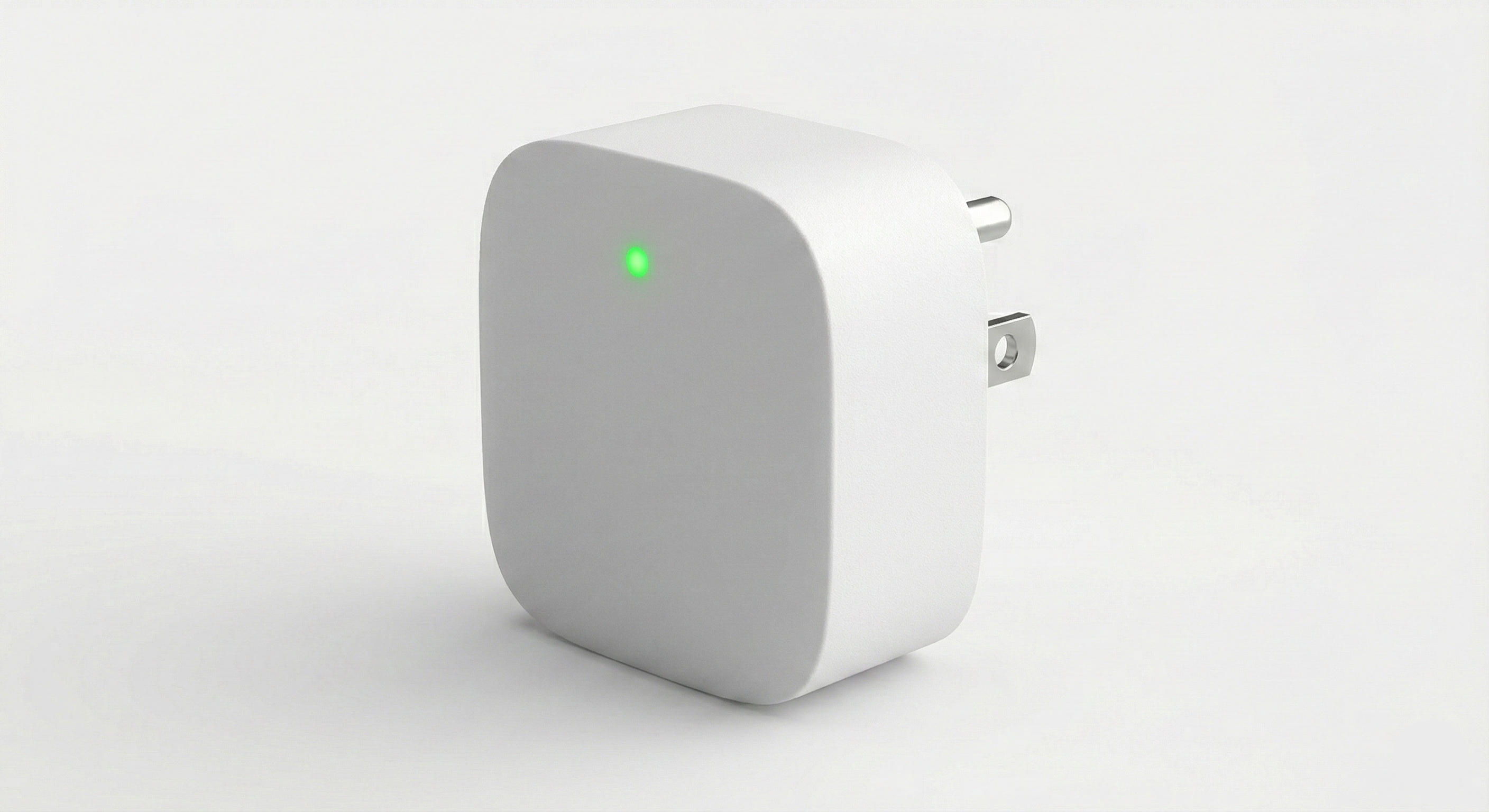
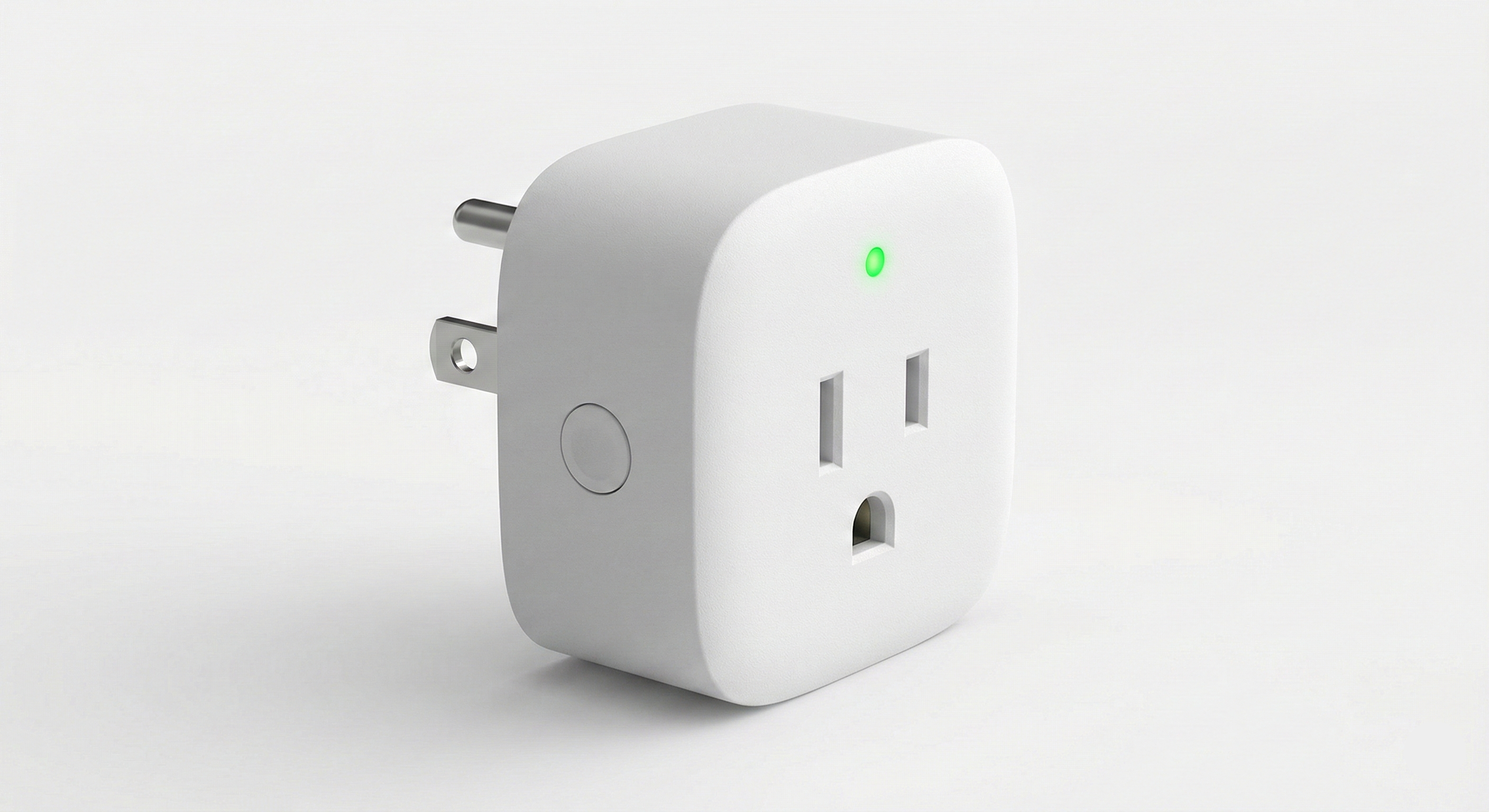
Standard protection doesn’t see the conditions that start many fires—until it’s too late.
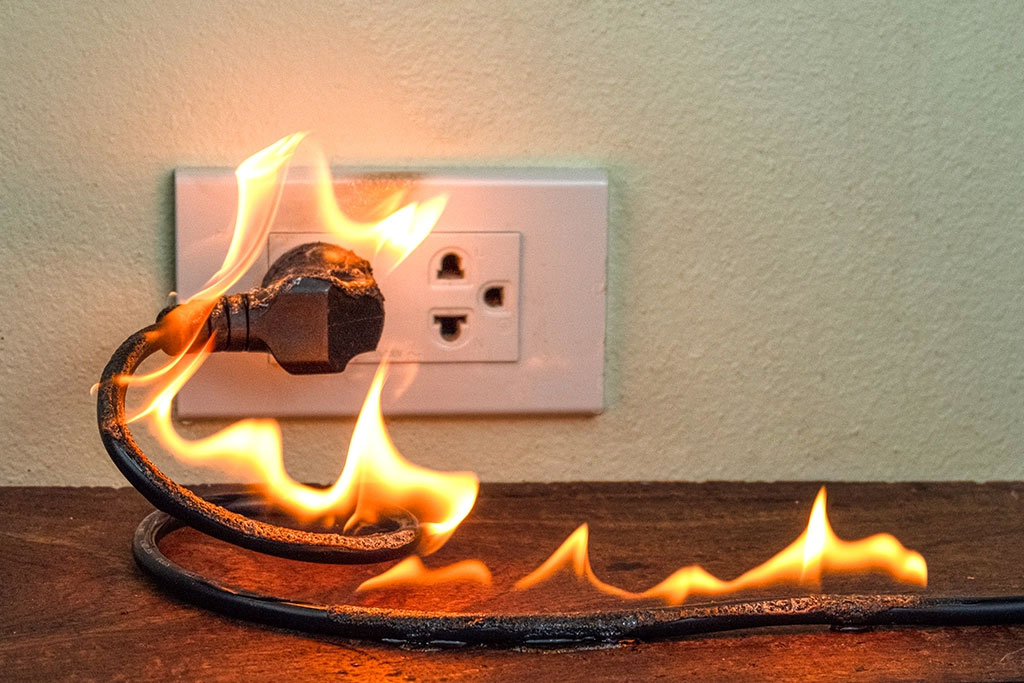
Image: John Nugent & Sons (September 24, 2025)
MCBs, AFCIs, and GFCIs don’t detect rising line resistance or the heat building up in conduit wiring and outlets. By the time something trips—or worse, catches fire—the hazard has been growing for a long time.
HeatSinc monitors the circuit for degradation, and alerts you before heat accumulates.
Source: ESFI (August 17, 2021)
| Device | What it watches | What it catches | High resistance faults |
|---|---|---|---|
| Circuit breaker (MCB) | Amps (current) | ✓ Overloads & short circuits | ✗ Current stays within breaker limits |
| GFCI / RCD | Current (leakage to ground) | ✓ Electrocution, water contact | ✗ No leakage occurs |
| AFCI | Noise (sparks) | ✓ Active arcing, sparking | ✗ Silent heat buildup |
| Surge protector | Voltage spikes | ✓ Lightning, grid swells | ✗ Ignores voltage drops |
| HeatSinc | Ohmic resistance | ✓ Heat dissipation, line resistance | ✓ Detects directly |
Loose connection adds resistance to the circuit
By Ohm's Law (I = V/R), current decreases
Sees "less current" and assumes "safer"—while heat builds (P = I²R)
Meanwhile, GFCI sees no leakage, AFCI hears no sparks, and surge protectors ignore voltage drops. Each device sees what it's designed to see—while the fault goes undetected.
HeatSinc measures resistance directly, so it sees the danger others can't.
While the wall appears cool, your outlet's dashboard reveals the full picture.
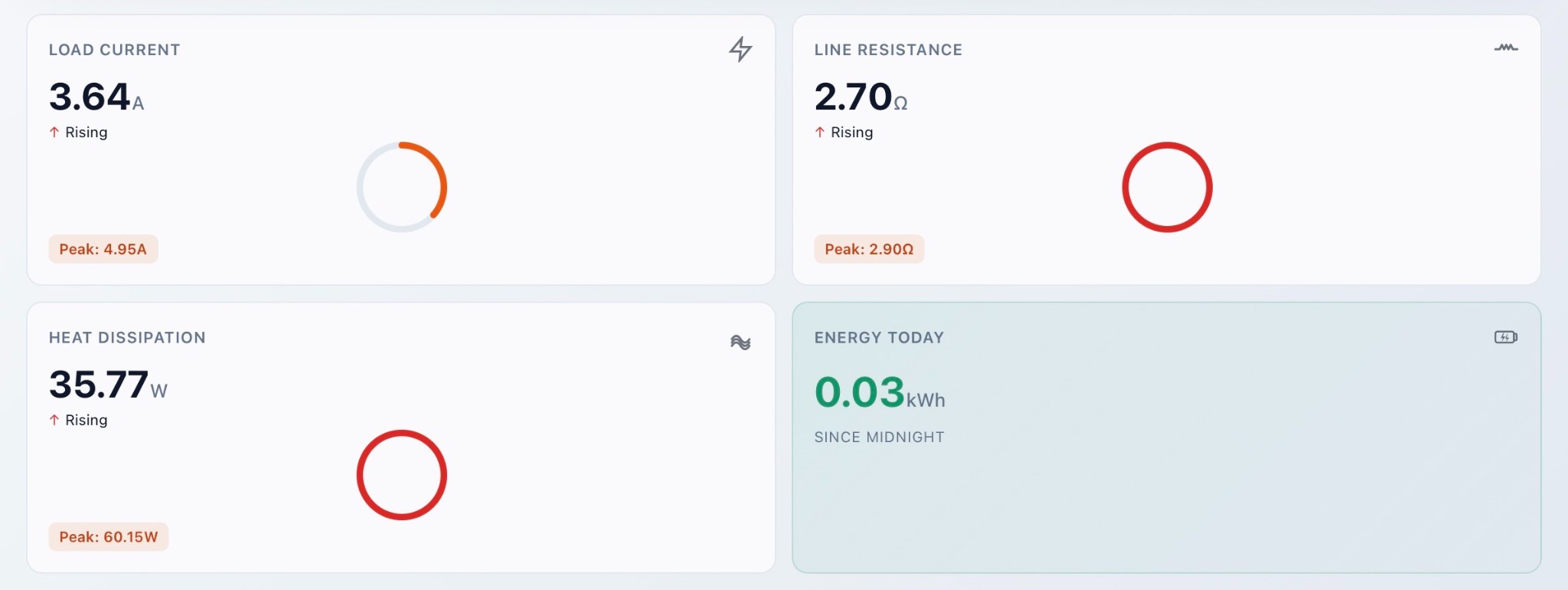
Real-time monitoring of load current, line resistance, heat dissipation, and daily energy consumption with trend indicators and peak values.
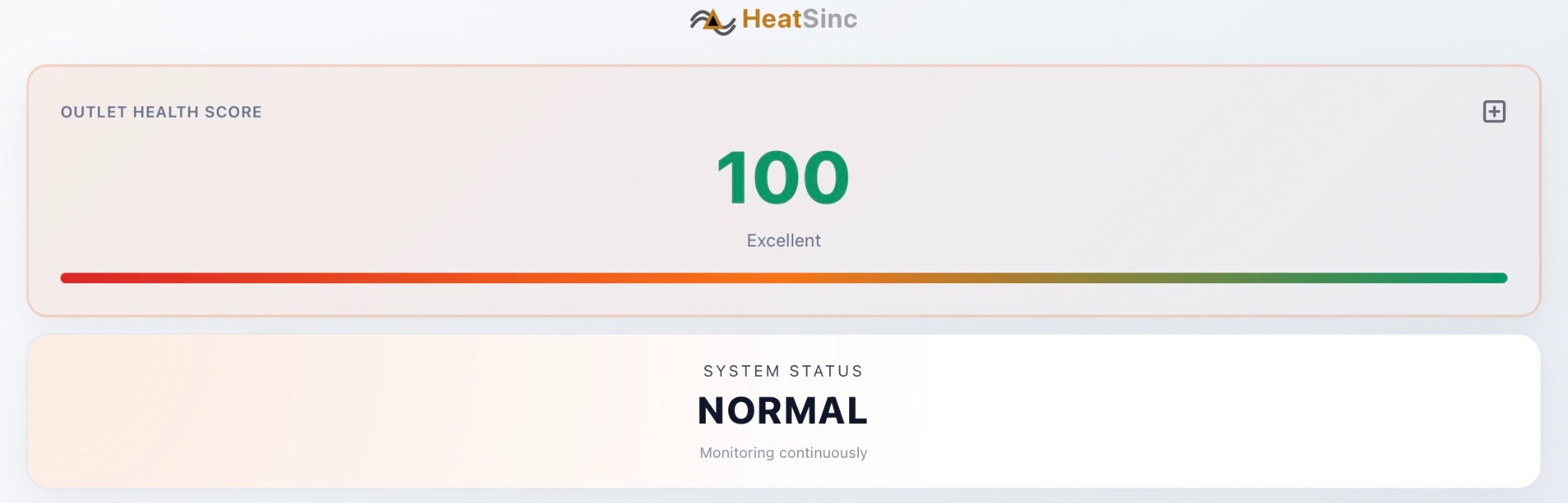
Normal operation: continuous monitoring with high outlet health score.
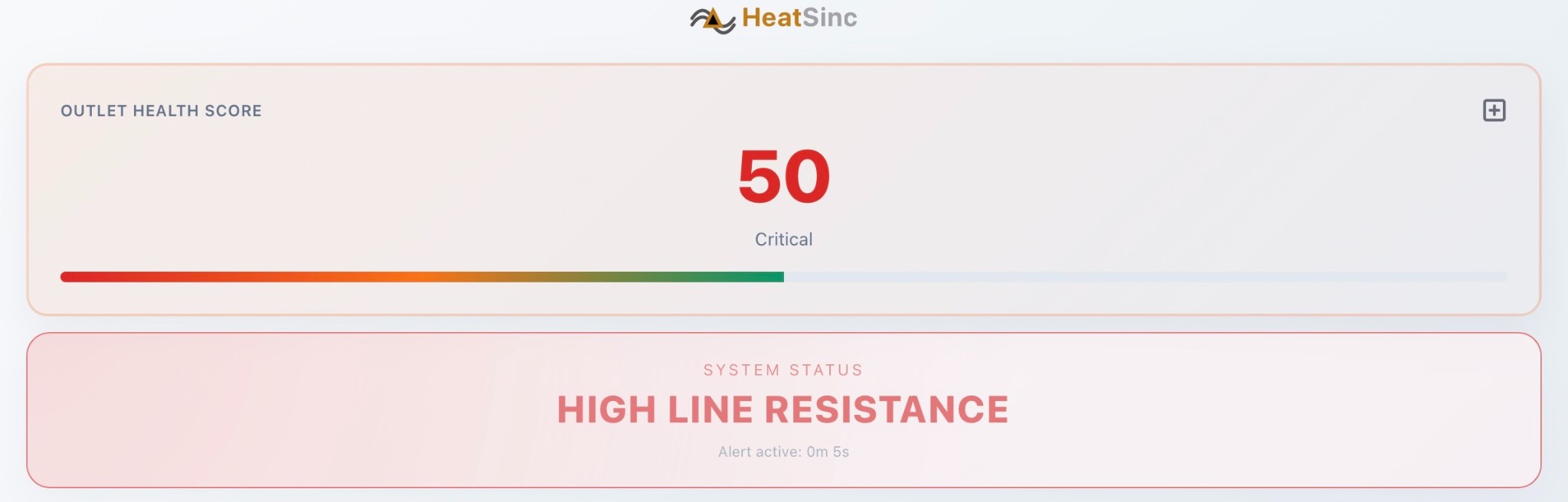
Alert state: system detects high line resistance and displays critical health score with active alert timer.
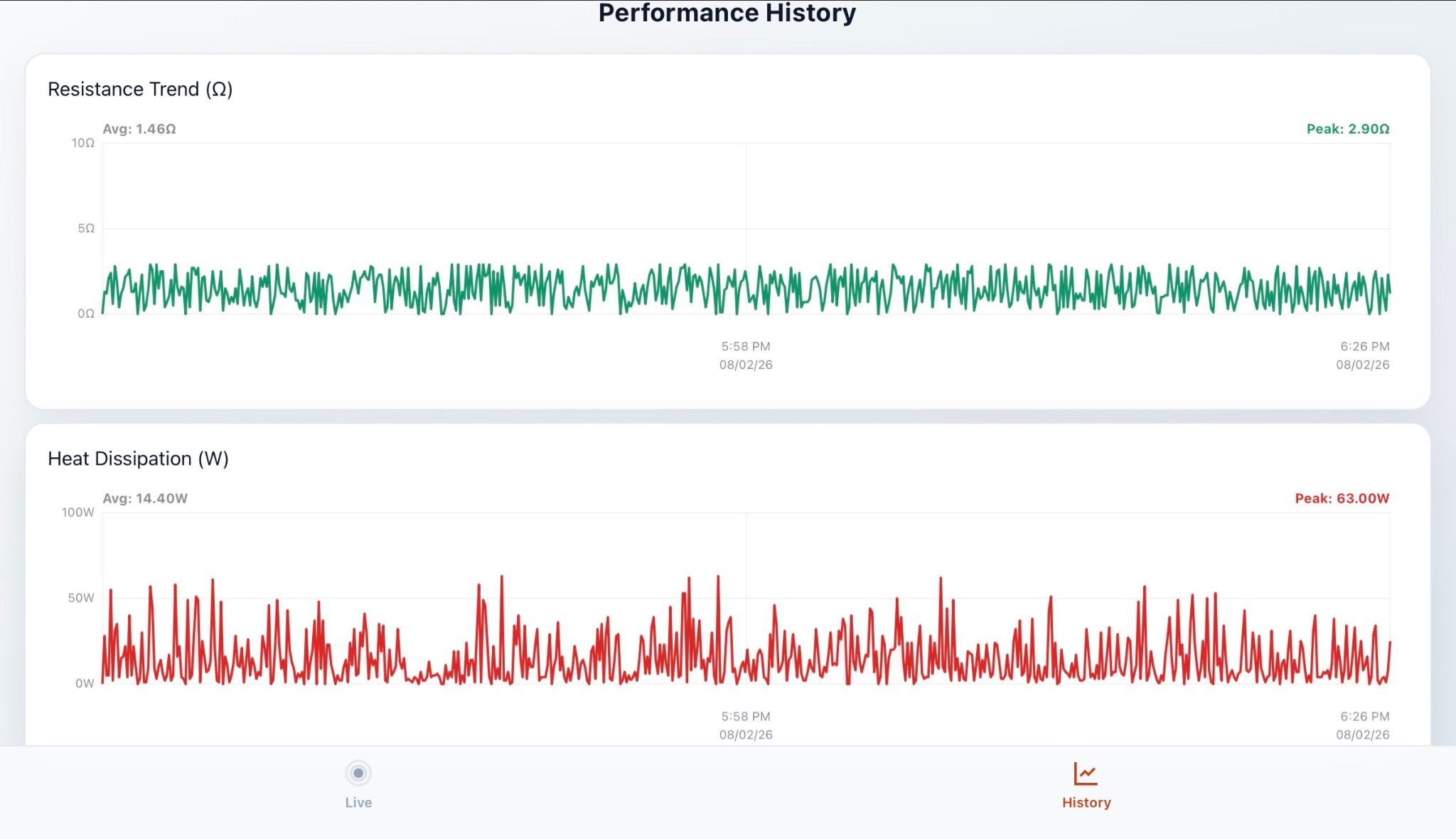
Historical trends show resistance and heat dissipation over time, with average and peak values for analysis.

Advanced diagnostics provide detailed metrics: voltage drop, phase shift, and timing jitter for technical analysis.
Hub (reference outlet) and Node (active outlet) synchronously sample voltage and current. Line resistance and power dissipation are derived in real time.
Edge logic flags overcurrent, high line resistance, and unsafe heat.
When thresholds are crossed, the system shuts off power and provides alerts.
Hub aggregates nodes; cloud dashboard and predictive maintenance are on the roadmap.
HeatSinc in action: from safe operation to fire hazard.
HeatSinc's rapid response to detected faults.
Prototype
Patent pending
Certifications (UL, CE, RoHS) and first pilots on the roadmap.
Circuit health monitoring
High line resistance and dangerous heat
HeatSinc prevents damage and alerts you before it’s too late.
Hardware + subscription
Per outlet + predictive maintenance
Hardware per outlet plus subscription.
1. Overloading (overcurrent)
2. High line resistance due to loose or damaged wiring
3. High power dissipation as heat
HeatSinc can be installed in offices, hotels, and homes; particularly where high-power appliances are used.
No. HeatSinc adds a monitoring layer on top of existing protection, catching what they don’t—without replacing them.
Wi‑Fi for cloud; Bluetooth for local outlet dashboards.
Interested in a demo, early access, or partnership? Share your needs and we’ll follow up.